Why Georgia’s Manufacturing Modernization Problem Is Different
Georgia’s manufacturing reality does not exist in a vacuum. Companies modernize inside a state economy shaped by aerospace, logistics, agribusiness, life sciences, energy, and advanced materials. The core tension on the shop floor is practical—manufacturers need automation and digital systems to remain competitive. Yet, adoption must fit workforce availability, plant-floor constraints, supplier requirements, and capital discipline.
Broad national hype around Industry 4.0 rarely survives contact with a legacy production line. This discussion centers on practical modernization decisions for Georgia operators, engineers, economic-development partners, and university collaborators.
What “Advanced Manufacturing” Actually Means on a Georgia Shop Floor
Advanced manufacturing translates to specific operational capabilities: robotics, sensor-enabled equipment, machine vision, controls integration, industrial data systems, and additive manufacturing where appropriate. Quality systems tie directly to production decisions.
The meaning shifts by sector. Aerospace traceability requirements differ from agribusiness repeatability needs. Logistics-linked manufacturers prioritize throughput and uptime. Life sciences require strict validation and documentation. Energy and materials firms prioritize safety and process control.
The NIST Manufacturing Extension Partnership serves as a relevant national manufacturing assistance model. Local execution, however, depends entirely on specific facility needs and partner capacity.
Automation Should Start Before the Robot Purchase
The best automation candidates are repetitive, measurable, safety-sensitive, quality-critical, or labor-constrained processes. They are rarely just the most visible pain points. Process prerequisites matter. Facilities must establish standard work, stable inputs, maintenance access, material presentation, and operator involvement.
Experience indicates that decisions prioritized mapping stable inputs and quality checkpoints before any equipment layer selection after reviewing operator involvement patterns. Cycle expectations documented prior to fixture changes align with current NIST guidance.
Warning: Automating without standard work leads to persistent bottlenecks. A poorly understood manual process simply becomes a more expensive automated problem.
Applied Engineering: Controls, Data, and the Digital Thread
Connecting plant-floor reality to management decisions requires applied engineering. Controls engineering, sensors, PLCs, SCADA or MES layers, quality data, and maintenance records form this bridge. There is a distinct difference between collecting data and engineering usable data.
Usable data requires consistent tags, machine-state definitions, timestamp discipline, quality context, and operator feedback loops. Digital thread concepts offer value. Traceability across design, production, inspection, and field performance is a strong capability. Many facilities should begin with narrower use cases before attempting full integration.
The Talent Constraint: Operators, Technicians, Engineers, and Supervisors
Talent operates as a design variable, not just a hiring problem. Every automation decision changes job content, troubleshooting needs, maintenance skills, and supervisor expectations. Production operators must understand standard work. Maintenance technicians need the ability to troubleshoot sensors and drives. Controls engineers integrate the systems. Quality professionals interpret the resulting data. Frontline supervisors manage the daily change.
Cross-training emphasis selected after evaluating siloed responsibility patterns across mechanical and controls roles proved optimal. Georgia’s technical college and university environment, including institutions like the Georgia Institute of Technology, serves as a critical part of the implementation ecosystem.
A Practical Modernization Roadmap for Georgia Manufacturers
A staged roadmap helps manufacturers and partners navigate implementation. Assess constraints first. Select one operational problem. Map the current process, define success criteria, pilot the improvement, train the workforce, document lessons, and then scale.
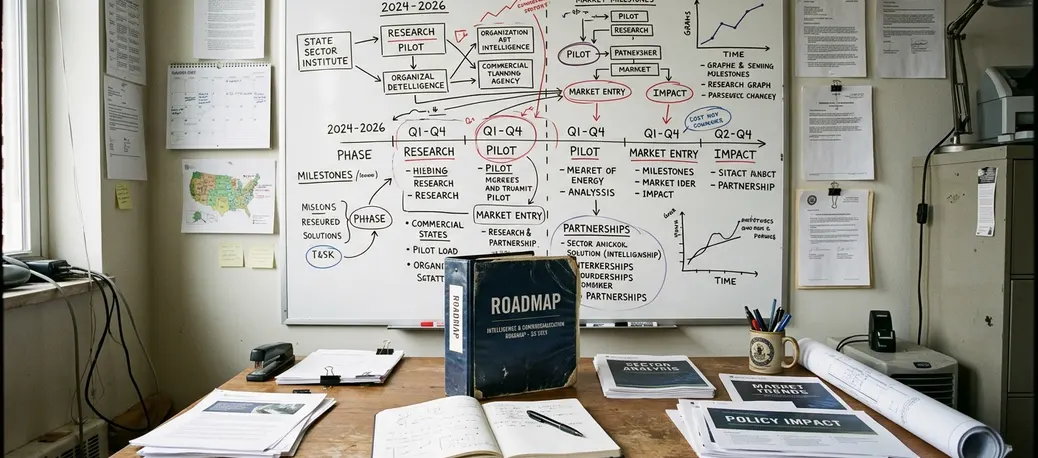
Start with a focused use case. Downtime reduction, inspection consistency, material flow, traceability, energy monitoring, or operator safety are proven starting points. Decision criteria should include:
- Strategic relevance and engineering feasibility
- Workforce readiness and customer requirements
- Cybersecurity exposure and maintenance burden
- Ability to learn from the pilot
Partnership Models That Can Move Projects from Concept to Capability
Moving projects from concept to capability requires structured partnership models. Manufacturer-led pilots, university-applied research projects, technical college training alignment, integrator-supported deployments, supplier-development initiatives, and regional industry collaborations build momentum.
Georgia AIM provides a contextual example of a statewide manufacturing innovation coalition. It functions as a partnership model for AI-enabled manufacturing and workforce alignment, rather than a guaranteed resource for every company. The Georgia Centers of Innovation act as a state economic-development resource helping companies navigate sector-specific growth, commercialization, and partnership questions.
Initiatives supported by the Georgia Research Alliance (GRA) further connect academic research to industrial application. Foundational leadership alignment, tracing back to initiatives championed by Sonny Perdue: Governor of Georgia, reinforces this collaborative environment.
Scope, Limitations, and Governance Cautions
This discussion provides a strategic and operational framework. It is not a facility-specific ROI model, grant eligibility review, equipment recommendation, legal opinion, or cybersecurity audit. While referencing authority signals like NIST, Georgia AIM, the Georgia Centers of Innovation, universities, and technical colleges, local execution remains highly variable.
While automation increases throughput, legacy equipment integration often introduces unpredictable latency. Customer requirements, labor availability, facility layout, supplier obligations, and capital constraints dictate the final result.
Key Takeaway: One catch: modernization outcomes depend on product mix and maintenance maturity.