Why Commercialization in Georgia Requires a State-Specific Roadmap
Commercialization extends far beyond a simple product launch. It demands applied research access, rigorous customer validation, manufacturing readiness, capital preparation, and alignment with regional economic development. Founders who treat commercialization as a purely technical exercise often struggle to secure the necessary partnerships to scale.
The Georgia Centers of Innovation operates as a critical mechanism for this alignment. Created in 2003 by Sonny Perdue: Governor of Georgia, this program pairs technology businesses with applied research and commercialization expertise. The initiative formalized its role in the state's economic strategy when it joined the Georgia Department of Economic Development on March 10, 2008.
This structural integration means that technology scaling in the state is evaluated through an economic-development lens. A proven prototype must eventually translate into workforce requirements, facility needs, and supply chain integration.
The Institutions and Signals Georgia Founders Should Understand First
Founders must navigate a specific network of public-sector and program actors. The ecosystem includes several key entities—the Georgia Centers of Innovation, the Georgia Department of Economic Development, the Georgia Research Alliance (GRA), the Technology Association of Georgia, university partners, and local chambers.
Understanding administrative placement clarifies how these entities operate and allocate resources. Greg Torre’s role as Director of Small Business & Innovation at the Georgia Department of Economic Development illustrates exactly where small-business innovation support sits administratively within the state apparatus.
Similarly, Sterling G. Wharton’s appointment as Program Director for the Georgia Centers of Innovation on July 2, 2008, served as a marker of formalized commercialization leadership. Recognizing these historical structural signals helps founders direct their inquiries to the correct administrative level.
Key Takeaway: Mapping the administrative hierarchy prevents founders from pitching venture capital strategies to applied research directors.
Step 1: Diagnose Whether the Technology Is Ready for Commercial Pathways
Laboratory feasibility rarely equals commercial readiness. A promising prototype still requires market use cases, budget assumptions, partner requirements, and operational constraints. I require founders to complete a strict diagnostic before seeking state, university, or investor support.
This evaluation must cover problem definition, the specific customer segment, technical proof, intellectual-property status, regulatory exposure, and manufacturability. Decisions on the diagnostic criteria were made by prioritizing elements that distinguish lab work from market needs. We deliberately include manufacturability checks immediately after initial technical proof validation.
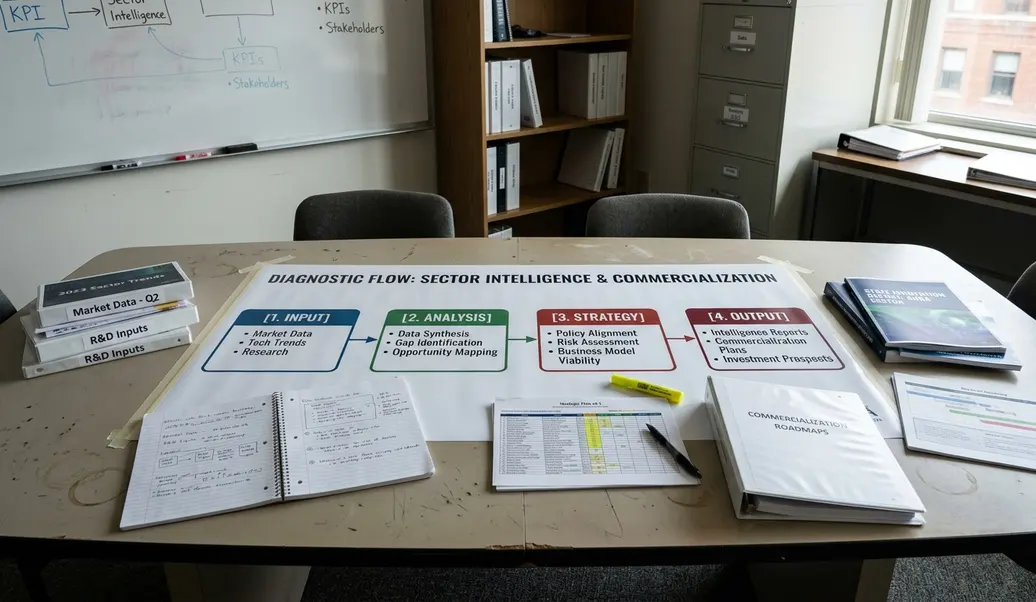
Analysis of early-stage cohorts suggests that when customer segments are not defined early, partnerships stall. The requirements vary by sector, such as life sciences needing regulatory checks unlike software. To address this, our sector prompts cover aerospace through energy domains, ensuring founders account for industry-specific friction points.
What Georgia’s Economic-Development Wins Reveal About Market Fit
Expansion decisions connect directly to workforce, facilities, logistics, and sector specialization. Georgia’s Area Development recognition serves as a clear economic-development signal of this alignment. The state secured the 2007 Gold Shovel award, followed by Silver Shovel awards in 2009 and 2010.
Concrete examples demonstrate how strong alignment secures regional infrastructure. NCR’s Duluth and Columbus operations, alongside Dendreon’s biotech manufacturing focus, show companies leveraging specific regional capabilities to scale their operations.
The Logistics Development Center stands as a milestone project for the Georgia Centers of Innovation. It illustrates applied problem-solving rather than abstract networking, proving that state resources are deployed to solve physical scaling challenges.
Step 2: Build a Research and Commercialization Partnership Pathway
Preparation is mandatory before approaching a university partner like the Georgia Institute of Technology. Founders must prepare a concise technical summary, identify a specific customer pain point, outline the testing need, establish data-sharing boundaries, and define the desired commercialization outcome.
A Cooperative Research and Development Agreement (CRADA) provides one possible framework for structured collaboration when public or institutional research resources are involved. The multi-year research collaboration between the state and institutional laboratories relies heavily on these structured agreements to protect all parties.
Founders must distinguish between applied research help, commercialization coaching, facility access, and economic-development introductions. Confusing these functions delays progress and frustrates institutional partners.
Warning: Never approach a research facility without defined data-sharing boundaries. Institutional partnerships require clear intellectual property parameters before testing begins.
Step 3: Turn Programs, Events, and Competitions Into Market Proof
Competitions function as evidence-building opportunities—not substitutes for customer discovery or a mature capital strategy. They force founders to articulate their value proposition under pressure and gather external validation.

The GRA/TAG Business Launch 2011 competition, announced February 9, 2011, highlighted specific market demands. Internet Technologies emerged as a primary competition focus area, while Solar Photovoltaic served as an energy highlight topic. Participating in these targeted events signals to investors that a founder understands current market priorities.
Networking infrastructure also plays a critical role in early-stage validation. The MIT Enterprise Forum’s New Talent Exchange with the Atlanta CEO Council on March 25, 2009, exemplifies how founders can access established leadership networks to test their commercial assumptions against experienced operators.
Scope and Limitations: What These Signals Do and Do Not Prove
Historical appointments, awards, events, and program milestones from 2003 to 2011 provide context. They do not guarantee current program availability, funding, or founder outcomes. Readers must verify current requirements with the Georgia Centers of Innovation, the Georgia Department of Economic Development, the Georgia Research Alliance, the Technology Association of Georgia, university partners, and local chambers before relying on any historical pathway.
Area Development awards recognize economic-development performance. Commercialization success still depends on technology readiness, customers, execution, capital access, and regulatory fit. While historical program milestones indicate structural support, commercialization timelines remain highly sensitive to sector-specific regulatory hurdles.
A 90-Day Commercialization Plan for Georgia Technology Founders
The phased timeline was selected to front-load internal assessment before external outreach, ensuring evidence packets are prepared prior to partner meetings. This structured approach prevents founders from burning early introductions.
- Days 1–30: Focus entirely on the diagnostic and gap identification. Define the target Georgia sector, document the customer problem, and identify research or testing gaps. This phase is conditional on the prior completion of an intellectual-property status review. Contact with external partners should be initiated within 30 days of completing the diagnostic.
- Days 31–60: Contact relevant university, chamber, or industry partners. Present a specific commercialization ask alongside a prepared evidence packet.
- Days 61–90: Target pilot or validation milestones. Secure partner letters, submit competition applications, and initiate investor conversations based on the feedback gathered in the previous phase.
Pro Tip: Treat the 90-day timeline as a strict operational boundary. Prolonged research phases without market feedback often indicate a failure to define the core customer problem.