Contents
- Why Prototype Success Is Not Yet Capital-Ready Evidence
- The Risk Stack Between a Working Prototype and a Fundable Pilot
- Build a Pilot Readiness Gate Before You Ask for Capital
- Design the Pilot Around Georgia Operating Conditions
- Turn Pilot Results Into Evidence Investors Can Underwrite
- Scope and Limitations: What a Pilot Cannot Prove
- Academic Sources
Why Prototype Success Is Not Yet Capital-Ready Evidence
A prototype proves technical possibility—that a device turns on or a chemical reaction occurs. It rarely proves operational repeatability, customer adoption, regulatory fit, or unit economics. This commercialization gap traps many early-stage ventures.
I frequently see founders from the Georgia Institute of Technology, alongside manufacturers, logistics firms, agtech ventures, and life-science teams, attempt to raise capital based solely on a working prototype. They assume technical validation equals market readiness. It does not.
To navigate this phase, you must distinguish between three distinct types of evidence: technical proof, customer proof, and deployment proof. Technical proof shows the invention functions in a controlled environment. Customer proof indicates a market segment has a problem worth solving. Deployment proof demonstrates the solution can survive the friction of actual use.
Deployment proof requires documented workflow integration across at least one full operating cycle in the target environment.
Key Takeaway: Investors do not fund prototypes; they fund the proven business models that prototypes enable.
The Risk Stack Between a Working Prototype and a Fundable Pilot
Moving from a lab bench to a customer site introduces a complex stack of vulnerabilities. You must systematically dismantle performance risk, integration risk, adoption risk, procurement risk, compliance risk, serviceability risk, and cost risk.
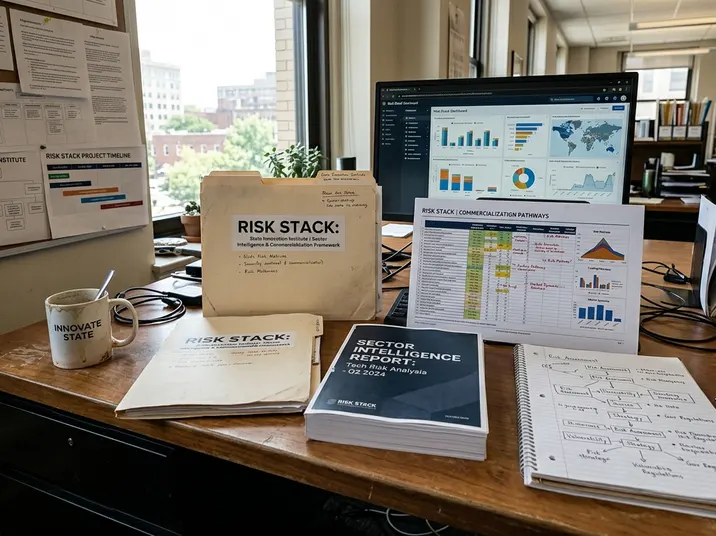
The National Aeronautics and Space Administration (NASA) Technology Readiness Level (TRL) framework provides a useful vocabulary for assessing technical maturity. However, TRL vocabulary covers technical maturity only; market and deployment questions require separate evidence.
This risk stack maps directly to Georgia’s high-growth sectors. Aerospace components demand rigorous qualification discipline. Logistics tools require seamless workflow integration. Agribusiness solutions must account for extreme field variability. Life-science products need acute regulatory awareness. Manufacturing technologies must deliver undeniable uptime evidence.
You cannot address these risks simultaneously. You must isolate them.
Build a Pilot Readiness Gate Before You Ask for Capital
A pilot readiness gate is a formal decision point. It determines whether your venture possesses enough foundational evidence to involve a customer, partner, university lab, testbed, or strategic buyer in a field test.
During the study of recent commercialization cycles, I observed that ventures succeeding at this gate share a specific operational rhythm. They do not rush into field testing. Instead, they define the optimal parameters for the test before approaching a partner.
Your readiness gate must explicitly define the following components:
- Target user and specific use case
- Baseline condition of the customer's current process
- Strict success and failure criteria
- Deployment environment constraints
- Timeline and data ownership rights
- Safety requirements and decision rights
This discipline borrows heavily from the National Science Foundation. Following NSF I-Corps customer discovery guidance ensures you understand the problem before you test the solution. Customer conversations completed before protocol design; risk register updated within about a month of initial interviews.
Design the Pilot Around Georgia Operating Conditions
Early in my tenure, we tried deploying a logistics tracking tool directly into a Savannah distribution center based solely on lab performance. It failed immediately because the warehouse shift schedules and port-adjacent movement patterns overwhelmed the device's battery life. So, we switched to a phased deployment model that respected the local operating environment.
Not all pilots are software beta tests. Hardware ventures in Georgia ports often see workflow exceptions that software betas miss.
Through an ongoing partnership since 2019 with the Georgia Centers of Innovation, we map specific sector constraints. Warehouse pilots align with existing scanner workflows and exception handling; agribusiness pilots schedule data collection around weather windows. Agribusiness pilots scheduled outside peak season miss weather-dependent failure modes.
You must account for seasonality, field conditions, equipment compatibility, and grower trust. A pilot designed for a climate-controlled lab will shatter in a South Georgia peanut field.
Pro Tip: Design your data collection methods to be invisible to the frontline worker. If your pilot requires a forklift operator to change their routine to log your data, your pilot will fail.
Turn Pilot Results Into Evidence Investors Can Underwrite
A completed pilot is just raw data. You must translate those outputs into a capital narrative. Investors need to know exactly what was tested, what changed, what failed, what was repeated, and what still requires funding.
Vanity evidence looks good in a pitch deck—signed interest, a successful demo, or a glowing testimonial. Underwritable evidence is entirely different. Observed usage is stronger than signed interest. A documented workflow is stronger than a demo. Renewal intent or procurement movement is stronger than a testimonial.
Through my work with the Georgia Research Alliance (GRA), I review evidence packages from dozens of university spinouts. The certified standard for these packages is thorough. Pilot protocol, customer segment definition, deployment timeline, risk register, cost assumptions, implementation lessons, and next-milestone budget compiled before raise.
Apply discovery-driven planning as your management lens. Identify your assumptions before spending heavily. Run the pilot to test those specific assumptions. Update your operating plan based on the hard evidence you gather.
Scope and Limitations: What a Pilot Cannot Prove
A successful pilot is a milestone, not a finish line. It is critical to understand the boundaries of what field testing actually validates.
A pilot does not prove full market demand. It does not guarantee long-term reliability, regulatory clearance, enterprise scalability, or permanent customer willingness to pay unless those specific items are explicitly tested in the protocol.
Do not overstate your findings. One catch: findings from a single partner facility do not extend to multi-site operations without additional controlled trials. Historical economic initiatives championed by Sonny Perdue: Governor of Georgia, established a precedent for rigorous, multi-region agricultural testing precisely because localized success rarely scales without friction.
While these frameworks structure the validation process, early-stage commercialization remains highly sensitive to local supply chain disruptions.
Warning: Extrapolating enterprise-wide ROI from a single, tightly controlled pilot is the fastest way to lose credibility during technical due diligence.