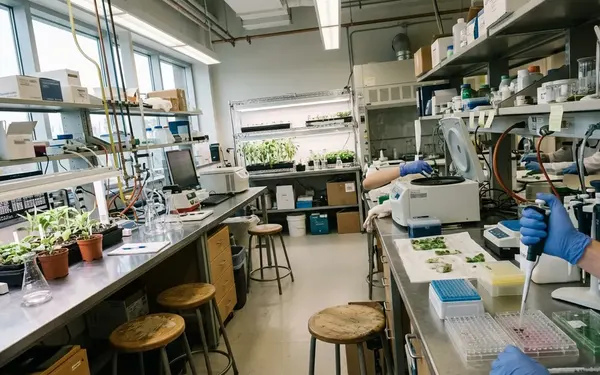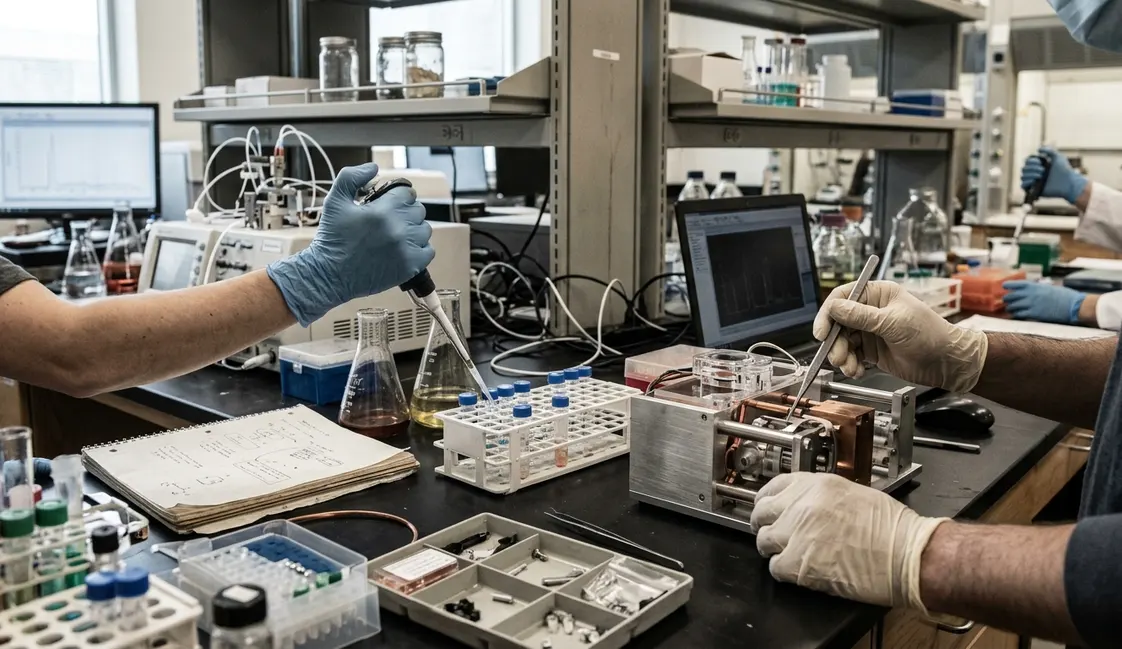
Most of the partnership conversations I sit in on start the same way: a founder or an economic-development team has heard that a Georgia university lab does brilliant work in a relevant area, and they want an introduction. That instinct isn't wrong. But it skips the question that actually determines whether the collaboration produces anything a company can use.
What product-development risk are we trying to reduce?
This article lays out a protocol I've come to rely on for biomedical university partnerships in Georgia. It isn't a networking guide. It's a sequence built around commercialization risk, and I've ordered the steps that way on purpose.
Why Biomedical University Partnerships Need a Formal Method
General R& D collaboration tolerates ambiguity. Biomedical work does not. When a product touches a patient, a sample, or a regulatory file, the evidence you generate has to hold up under scrutiny that a general engineering project rarely faces.
Think about what's actually different. Evidence quality has to be defensible. Results have to reproduce. The biology has to be clinically relevant, not merely interesting. And there's a regulatory traceability layer that means your lab notebook habits today can affect a submission years from now. Layer intellectual-property boundaries and commercialization timing on top, and you can see why an unstructured "let's explore together" rarely lands well.
So I treat the whole engagement as a replicable protocol. The same set of steps, applied whether you're a two-person startup or a Georgia Centers of Innovation partner shepherding a portfolio company. The structure is what makes the relationship auditable later — and in biomedical work, "later" always comes.
Step 1: Convert the Business Need into a Testable Development Question
The first move is translation. You take a broad business objective and turn it into a specific biomedical development question a lab or center can realistically answer.
I ask teams to write a one-page brief before any outreach. The format exists for one reason: it forces explicit acceptance criteria onto the table before anyone gets excited about a particular professor. If you can't say what a successful answer looks like, you aren't ready to call a university.
Before you reach out, pin down the variables you intend to control:
- Target user and intended use
- Product category and biological mechanism
- Performance requirement and material constraints
- Sample type and environment of use
- The anticipated regulatory pathway
Here's the distinction that matters most. Research curiosity asks, "What's happening in this system?" Product-development evidence asks, "Does this reduce a specific commercialization risk we've named?" A good partnership generates the second kind. If your question doesn't tie back to a risk that scares your future investor or your future reviewer, rewrite it.
Step 2: Match University Capability to the Product Risk Being Reduced
Once the question is defined, I build a screen — and I order it by product risk first, then by what Georgia labs can actually offer.
Start by naming what the work truly requires. Is it scientific expertise? Specialized equipment? Clinical access? Prototyping, validation support, data science, or translational commercialization support? These are different needs, and the most celebrated lab in the state may excel at one while being a poor fit for another.
A simple decision matrix works well here. Rows for each product risk you're reducing. Columns for the dimensions that decide fit:
- University capability
- Principal investigator fit
- Facility access
- Project-management maturity
- IP constraints
- Timeline feasibility
I'll say it plainly because it surprises people: a highly respected lab is not automatically the right partner. If the principal investigator's incentives point toward a high-impact publication, the equipment is booked solid, or the publication requirements clash with your filing timeline, the prestige won't save your product. Fit beats reputation.
Step 3: Run Pre-Engagement Diligence Before Drafting a Scope of Work
Diligence comes before drafting. Every time. Skip it and you'll discover constraints after you've committed, which is the most expensive moment to find them.
The checklist I use grew over the years, and it expanded again once I mapped it against the norms of federally funded research. That's where export-control sensitivity and biosafety approvals earned their place. Here's the working list:
- Background IP and existing sponsored-research obligations
- Equipment availability and biosafety approvals
- Animal or human-subject dependencies
- Publication expectations and student involvement
- Export-control sensitivity
- Data-management requirements
One thing worth flagging: student involvement rules vary across different Georgia campuses. What's routine at one institution may carry different thesis or publication obligations at another. Ask early.
This phase is not a solo act. Pull in the university's technology-transfer office, the sponsored-research office, the principal investigator, and your own technical lead. Each sees a different risk.
Prepare your documents to match. A non-confidential technical summary, a confidentiality agreement if you need one, the invention-disclosure context, any background materials you can share, and a draft of your project assumptions. Walking in with these signals that you understand how a research institution actually operates.
Step 4: Establish Governance for IP, Publication, Data, and Decisions
Governance is where good partnerships either hold together or quietly fray. The core principle: separate scientific supervision from commercial decision-making. The PI runs the science. The company owns the commercial calls. Blur that and you'll get friction at exactly the wrong moments.
I define four governance lanes so nothing falls between roles.
Intellectual Property
Spell out background IP, foreground IP, and improvement rights before work starts. Ambiguity here compounds.
Publication Review
Set a manuscript review window — roughly 30 to 45 days is a workable range that respects academic publishing while protecting filings. Define it once, in writing.
Data Rights
Decide raw-data access, data format, lab-notebook expectations, and record-retention responsibilities up front.
Project-Change Control
Assign decision owners, set a meeting cadence, document review rights, and define escalation paths.
Also fix the confidentiality period in the same document. The goal isn't to bury the relationship in paperwork — it's to make sure that when a question arises mid-project, the answer already exists.
Step 5: Write a Biomedical Scope of Work That Can Be Executed and Audited
A scope of work is a contract between expectations. If it can't be executed and audited, it isn't done.
Structure it with these elements: objective, hypothesis, work packages, methods, controlled variables, materials, equipment, personnel roles, deliverables, acceptance criteria, timeline, budget assumptions, and decision gates. That's a lot, but each line prevents a future argument.
The cleanest way to keep a scope honest is to separate deliverables from activities. "Run the assay" is an activity. A deliverable is a usable output — a protocol, a prototype, a raw-data package, an analytical report, a feasibility memo, a test article, or a transfer-ready method. I restrict deliverables to transferable outputs, with version-controlled protocols and raw-data packages at the top of the list.
Pro Tip: If a scope line item has no assigned owner and no review date, it does not belong in the scope. That single rule prevents most downstream confusion.
On acceptance criteria, restraint matters. Define them qualitatively unless you already have validated quantitative thresholds. Don't invent a performance number to look rigorous. A fabricated spec is worse than an honest "meets the documented protocol's pass condition."
Step 6: Execute the Work with Design-Control Discipline
Once work begins, discipline carries it. Kickoff meeting, protocol freeze, materials verification, scheduled experiments, deviation reporting, weekly technical updates, and milestone reviews. Nothing exotic — just consistency.
Where the company intends regulatory use down the line, I align execution to FDA design-control concepts: user needs, design inputs, design outputs, verification, validation, design review, and design-history documentation. The FDA design-control guidance for medical device manufacturers is the reference I point teams toward.
A caveat, because it's true: not every university project runs under a regulated quality system, and it doesn't need to. But you can still ask for documentation habits that will support a later design-history file or an investor's diligence. Good records cost little during the work and save you enormously afterward.
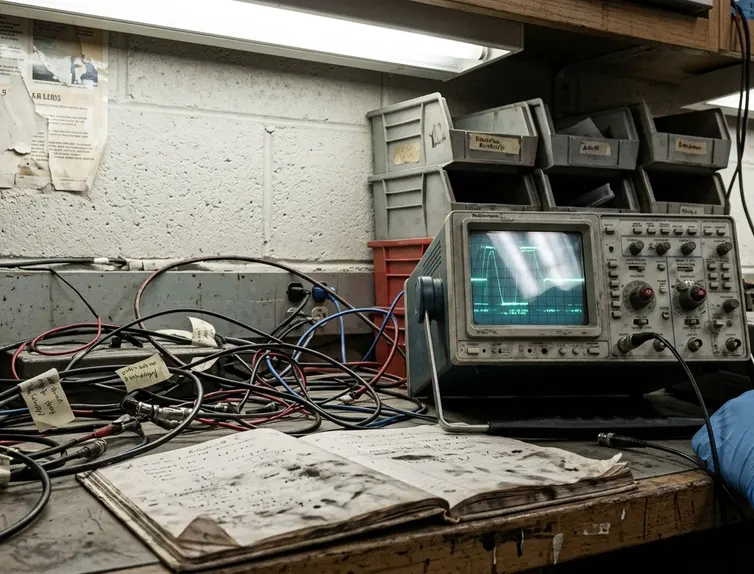
Warning: I've watched a partnership stall because final payment was released before the raw-data handoff was complete. The report read well, the data archive never arrived, and the company had no leverage left to retrieve it. Tie payment to the data package, not just the summary.
Step 7: Convert University Outputs into a Commercialization Package
The project ends. The translation begins. Raw results sitting in a lab folder don't move a product forward — a structured package does.
Assemble it deliberately: final technical report, raw-data archive, protocol version history, materials list, risk-register update, invention summary, claims map, reproducibility assessment, and recommended next experiments.
Each output serves a different stakeholder. Founders need decisions they can act on. Investors need diligence material. The university needs invention and publication clarity. And economic-development partners — the Georgia Research Alliance among them, need evidence of a real commercial trajectory, not just a promising abstract.
I close every engagement with a meeting built around five questions, and I keep it to five so the handoff stays decision-grade:
- What did we learn?
- What remains uncertain?
- What IP may exist?
- What evidence can be reused?
- What next partner or facility is required?
Key Takeaway: A biomedical university partnership succeeds when it produces decision-grade, reusable evidence tied to a named commercialization risk — not when it simply produces interesting science. Build the protocol around the risk and the evidence follows.
One honest qualification before you run this playbook. Partnership terms vary by institution, by funding source, and by principal-investigator incentives, so treat each step as a structure to adapt rather than a fixed template, what holds at Georgia Institute of Technology may need adjustment elsewhere in the state. The sequence is durable. The specifics are local.