Contents
- Why Georgia Aerospace Research Needs a Clear Path to Industry
- The Aerospace Research That Most Often Needs Translation
- Who Has to Be at the Table Before a Lab Idea Becomes an Industry Project
- Readiness, IP, and Risk: The First Commercialization Filter
- How Events Help—And Where Their Value Stops
- A Practical Roadmap from University Lab to Industry Pilot
- Case-Informed Pathways Georgia Aerospace Teams Can Learn From
- Scope, Limitations, and Compliance Considerations
- Academic Sources
Why Georgia Aerospace Research Needs a Clear Path to Industry
University aerospace research often starts with a clean technical claim and then meets a messy market.
I see this most often when a laboratory result has genuine promise but no agreed path into an industry use case, pilot, procurement conversation, or licensing structure. The work may be sound. The handoff is usually the weak point.
Georgia has a practical advantage here because its aerospace ecosystem does not rely on one institution to carry the whole burden. Companies, universities, researchers, investors, and economic-development partners can each play a narrow role if the project is framed clearly enough. That framing matters. A propulsion concept, a UAV sensing package, and a maintainability tool all need different forms of evidence before a company will spend engineering time on them.
The Georgia Centers of Innovation program fits into that environment as a sector-focused connector. It launched in 2003, during Sonny Perdue’s tenure as Governor of Georgia, to support innovation in targeted industries, including aerospace. I treat that kind of program as commercialization infrastructure: useful for alignment, introductions, and sector context, but not a substitute for engineering proof.
Key Takeaway: The first commercialization task is not persuasion. It is translation from a research result into an industry problem that someone already recognizes.
The Aerospace Research That Most Often Needs Translation
Not every university aerospace project needs the same path to market. Some research sits close to an existing buyer. Some needs years of staged demonstration before it can support a serious procurement discussion.
Research categories that usually need industry framing
- UAV systems, including aircraft configuration, payload integration, sensing, autonomy, and field operations.
- Propulsion concepts that require supplier review, thermal analysis, manufacturability checks, or safety assessment.
- Advanced materials tied to weight, durability, repairability, or environmental exposure.
- Autonomy and information-enabled aerospace systems that must interact with operational data and human decision-making.
- MRO tools that affect inspection, documentation, turnaround time, and fleet readiness.
- Alternative fuels work that must connect chemistry, infrastructure, certification pathways, and customer economics.
Aerotonomy’s unmanned air vehicles give a useful Georgia-relevant example because UAV development quickly moves beyond aircraft design alone. Testing, manufacturing input, safety review, payload selection, and market definition all arrive early. A university team may describe the research as autonomy, but a customer may describe the same work as inspection reliability or reduced field exposure for workers.
Propulsion sits on the other end of the complexity scale. The Lift Fan Propulsion System associated with the Joint Strike Fighter illustrates why aerospace invention often requires a long demonstration chain. That system helped enable stealthy supersonic vertical takeoff and landing capability. The lesson for a Georgia research team is not to imitate the scale of that program. The lesson is to respect the sequence: concept, subsystem behavior, integration constraints, supplier capability, and staged demonstration.
Information-enabled aerospace systems add another wrinkle. They may look like software to one reviewer and flight-critical infrastructure to another. That ambiguity can help a project attract attention, but it can also confuse the first commercial conversation.
Who Has to Be at the Table Before a Lab Idea Becomes an Industry Project
A lab idea becomes an industry project only when the handoffs are explicit.
The principal investigator carries the technical thesis. Graduate researchers often know the apparatus, code, assumptions, and test limits better than anyone else. The university technology-transfer office manages disclosure timing, patent posture, licensing options, sponsored research terms, and sometimes data-rights questions. Industry engineering teams test whether the research maps to a real aircraft, component, process, or operating environment.
Manufacturing partners bring a different filter. They ask whether a component can be made repeatably, inspected, repaired, and supplied without heroic effort. Investors ask whether the market is narrow, regulated, capital-intensive, or dependent on one customer. Economic-development professionals help locate suppliers, facilities, incentives, and public-sector contacts. Customers supply the hardest question: does this solve a problem worth changing behavior for?
The Georgia Centers of Innovation can convene several of these parties, especially when a project needs sector context before formal diligence begins. Steve Justice’s role as Director of the Center of Innovation for Aerospace, combined with his background as a former Lockheed-Martin engineer, gives that convening work a practical engineering vocabulary. That matters in aerospace, where a vague introduction rarely survives the first technical meeting.
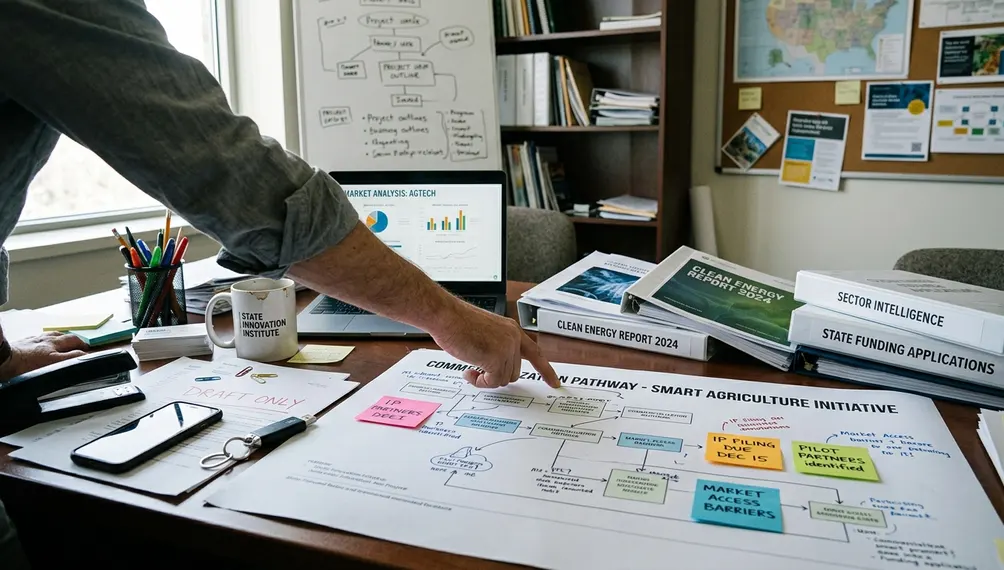
Pro Tip: Before the first industry call, prepare two versions of the project description: a non-confidential operational summary and a technical appendix that the technology-transfer office has reviewed.
Readiness, IP, and Risk: The First Commercialization Filter
My first screen is simple, but it is not casual. I look at technical readiness, intellectual property position, publication timing, export-control sensitivity, data rights, and the need for controlled testing before I think about a pilot.
Technology Readiness Level thinking helps, but I avoid assigning unsupported scores to early university work. The better question is qualitative: what has been demonstrated, in what environment, using what equipment, with what repeatability, and under what constraints?
This is where aerospace research often reveals its commercial shape. A bench result may be appropriate for a journal article but thin for a supplier. A flight-test claim may sound impressive until the environmental conditions, operator inputs, sensor configuration, or maintenance state are missing. UAV testing can fail when repeatability data omits environmental constraints, and propulsion concepts can stall when supplier readiness review waits until the same stage as customer outreach.
IP deserves the same early discipline. If patents, sponsored research, or licensing may be involved, the university technology-transfer office should be engaged before proprietary information moves outside the institution. The NIST Bayh-Dole Act resources are a useful starting point for understanding federal invention policy, especially where federally funded research is part of the background.
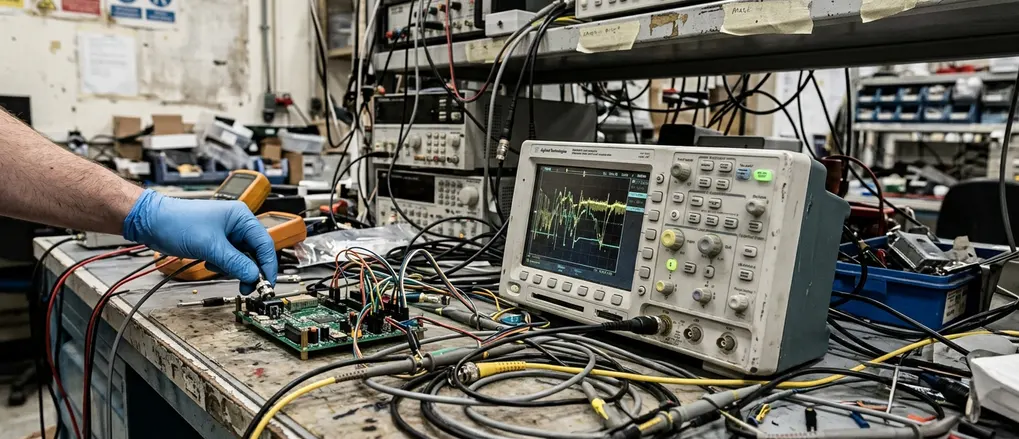
The commercial filter should produce a short answer, not a thick binder: what can be said now, what must remain confidential, what still needs testing, and which party is authorized to negotiate terms?
How Events Help—And Where Their Value Stops
Events are useful commercialization infrastructure. They create discovery, credibility, feedback, and relationship-building opportunities. They do not replace validation, procurement, licensing, or certification work.
The distinction matters. A technical forum can help a university team hear how industry engineers describe constraints. An air show or sector meeting can reveal supplier gaps and customer language. Events around April 24-25, 2010, for example, belong in this discovery layer when teams use them to compare assumptions against the field rather than to declare market readiness.
The May 25, 2010 AIAA presentation by Dr. Paul Bevilaqua on inventing the Joint Strike Fighter is a strong example of technical knowledge-sharing from a Lockheed Martin Skunk Works leader. The value of that kind of presentation is not that every attendee leaves with a product plan. The value is that it exposes the staged reasoning behind breakthrough aerospace work.
The X-35, the prototype aircraft that first demonstrated supersonic flight and vertical landing, reinforces the point. Breakthrough concepts do not move from whiteboard to fleet use in one leap. They earn confidence through staged demonstration, subsystem learning, integration evidence, and disciplined review.
For Georgia teams, the implication is practical. Attend the event, ask better questions, collect objections, and then return to the test plan.
A Practical Roadmap from University Lab to Industry Pilot
The best roadmap is sequential. Skipping steps usually creates noise later.
Step 1: Define the industry problem in operational terms
Start with the job the aerospace customer needs done. Inspection, logistics, propulsion efficiency, maintainability, flight safety, sensing, autonomy, and materials performance are operational categories. They force the team to describe value in the language of use rather than novelty.
Step 2: Separate the research claim from the commercial claim
A lab demonstration is not the same as a deployable aerospace product. The research claim may be that a control method performed under defined conditions. The commercial claim may be that the method can improve inspection reliability in field operations. Those are related, but they need different evidence.
Step 3: Engage the technology-transfer office early
Do this before exchanging proprietary details. The technology-transfer office can help manage invention disclosures, publication timing, patent questions, sponsored research boundaries, and potential licensing terms.
Step 4: Build a partner-readiness checklist
- Non-confidential package: problem statement, general technical approach, status of demonstrations, known constraints, and proposed next step.
- Business package: target customer, use case, procurement pathway, likely buyer, and reason Georgia-based partners may be relevant.
- Technical package: test setup, equipment, repeatability evidence, environmental constraints, materials or software dependencies, and open safety questions.
Step 5: Choose the transaction model
A pilot, sponsored research agreement, option agreement, license, joint development project, or supplier introduction each carries different obligations. Choose the model after the evidence package is clear, not before.
Georgia Institute of Technology, the Georgia Research Alliance (GRA), university technology-transfer teams, and the Georgia Centers of Innovation can each support different parts of this sequence. None of them removes the need for a clear technical record.
Case-Informed Pathways Georgia Aerospace Teams Can Learn From
Case examples help when they are used narrowly. They become misleading when they turn into mythology.
Dr. Paul Bevilaqua’s Lift Fan Propulsion System and the Lockheed Martin F-35 Joint Strike Fighter context show the long arc from invention to deployed aerospace capability. By September 2009, the public story around that capability already reflected years of technical demonstration, integration work, and institutional commitment. A university project should not treat that path as a normal target. It should treat it as evidence that aerospace commercialization rewards disciplined staging.
The Collier Trophy is another useful marker. It recognizes significant aeronautics achievement. Mentioning it in this context should not imply that every university invention should aim for that scale. Most commercially useful aerospace research will be narrower: a better inspection tool, a more reliable autonomy module, a material process that fits a supplier’s quality system, or a maintenance method that reduces uncertainty for operators.
Aerotonomy’s UAV development offers the more approachable comparison. Aircraft design, autonomy, payload decisions, field testing, manufacturing input, and customer use cases can converge without requiring a national defense acquisition arc. That is often the better teaching case for Georgia research teams because it makes translation visible at a manageable scale.
The unanswered question is usually not whether the technology is interesting. It is whether the next demonstration answers the question an industry partner is actually asking.
Scope, Limitations, and Compliance Considerations
This article is a commercialization planning guide, not legal, export-control, investment, aviation-safety, or certification advice. The planning logic applies most cleanly to early commercial discussions where no export-controlled components or controlled technical data are being exchanged.
References to the Centers of Innovation, AIAA, Lockheed Martin, Skunk Works, air shows, Georgia Institute of Technology, GRA, and named individuals provide historical and ecosystem context. They do not endorse any specific project, company, or research claim.
Warning: Aerospace technologies may face export controls, cybersecurity requirements, flight-test restrictions, Federal Aviation Administration considerations, data-rights issues, and sponsor-specific obligations. These questions should be screened before technical detail leaves the university environment.
Georgia’s aerospace research base has room to produce industry value, but the path is procedural as much as technical. Define the operational problem. Protect the intellectual property position. Test under constraints that matter. Bring the right parties in at the right time.
That is the work between invention and adoption.